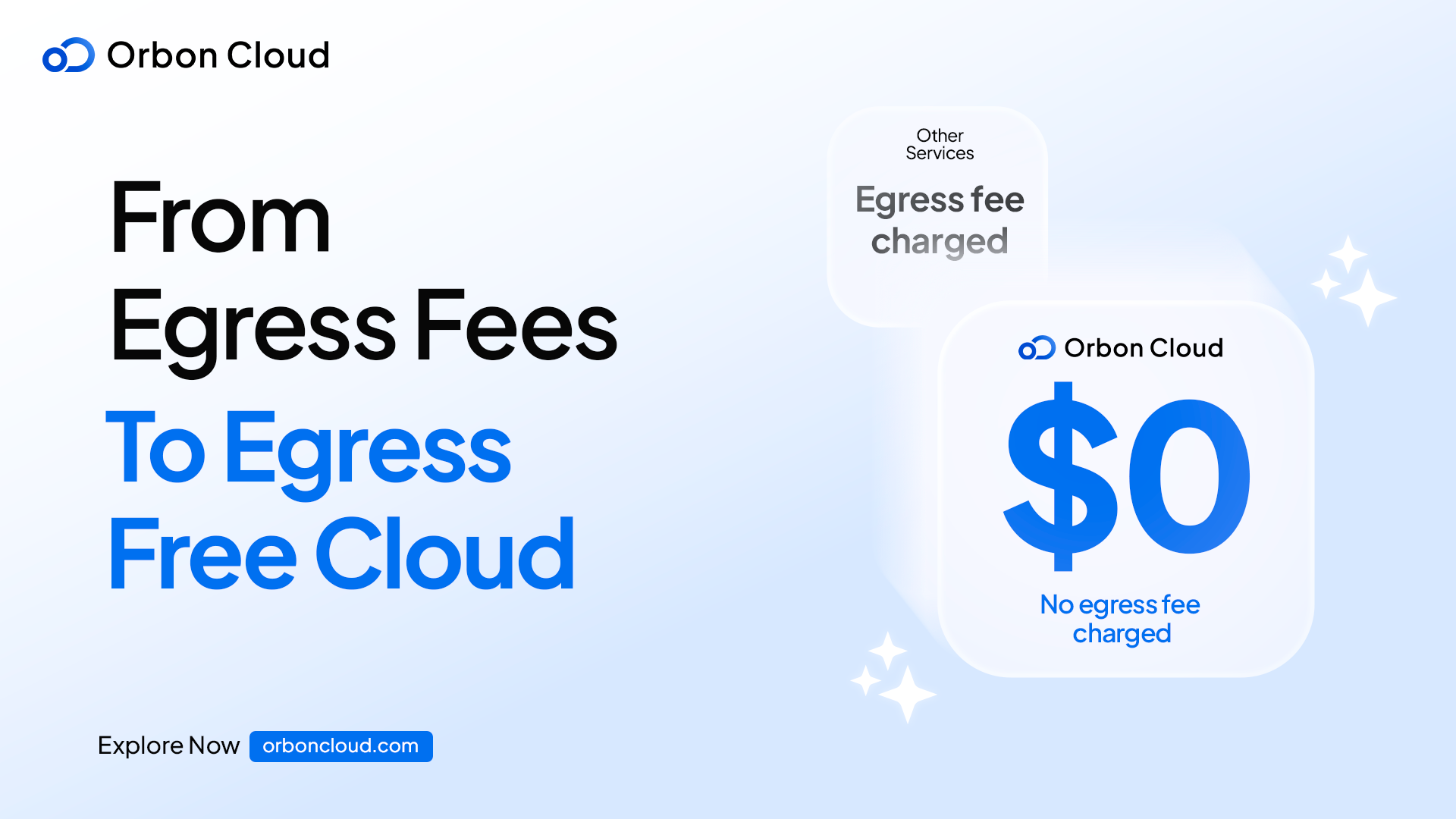
For the better part of a decade, the migration to cloud infrastructure was sold on a simple, intoxicating promise: flexibility. The promise was that by ditching on-premise solutions, you would gain the ability to scale up instantly, deploy globally, and innovate faster. You only pay for what you use, and you can access your data from anywhere. The pitch was perfect.
But as the industry matured and demand surged, the invoices also surged with ita a different reality began to take shape. While uploading data to the cloud was frictionless and free, accessing and retrieving it was a different story entirely.
This is the "Hotel California paradox” of modern cloud computing: you can check in your data at any time you like, but your data can never leave, at least, not without a hefty punitive fee for Egress. This bill is known as the Egress fee, and for years, it has quietly shaped the Cloud Storage sector and has served as the top vendor lock-in strategy for cloud providers.
However, times are changing. In this new era of ‘Cloud 2.0’, as we call it, there has been the emergence of cloud utility solutions that stack on your existing cloud architecture to solve specific use cases such as cost optimization. A zero-egress cloud storage solution is not just a pricing tweak or a discount strategy. It represents a fundamental architectural shift and is the game-changer that finally fulfills the original promise of the cloud, transforming data from a static, taxable asset into a flexible resource that truly belongs to you.
To understand why a zero-egress fee model is so important for you, we first have to look at its psychological impact. Egress fees are charges applied when data is retrieved or even accessed from your designated region on the cloud provider network. On a spreadsheet, they look like a standard utility cost, perhaps a few cents per gigabyte. But at the enterprise scale, where petabytes of data are in play, these “cents” compound into several thousands and millions of dollars.
The real cost, however, isn't just financial; it’s also behavioral.
When engineers and IT architects know that touching their own data from another region triggers a penalty, they tend to become miser with the innovative things they could have done with that data; let alone migrating that data out of the cloud provider entirely. They design systems not based on what is technically innovative, but on what is financially safe. This creates a phenomenon known as "data gravity."
This basically means that as your dataset grows in one cloud, it becomes increasingly heavy and expensive to move. Eventually, the gravity becomes so strong that you stop looking at other tools, other providers, or other possibilities to migrate your data to. You stay put, not because you want to, but because you can’t afford the exit toll. This is one of the legacy cloud’s biggest vendor lock-in strategies.
But what is this new solution from the Cloud 2.0 era all about?
Nowhere is the impact of egress fees more dangerous than in the realm of Data Backup (DB) and Disaster Recovery (DR). The logic behind it is simple: you back up your data by making and storing a copy of your data so that if the worst happens, be it a ransomware attack, a corruption event, or a service outage, you can recover your data.
In a cloud architecture where you are using legacy cloud providers for your Backup and Recovery, your data restoration process is penalized with heavy egress fees, depending on the file size involved. You are likely paying for the storage to back up the data, and definitely getting a bigger bill downloading the data to restore your systems.
This creates a perverse incentive structure where companies are discouraged from testing their recovery plans. A comprehensive DR test involves pulling large amounts of data to simulate a full restore. If that test costs thousands of dollars in fees, IT directors and definitely the finance department will oppose the idea and frequency of testing. They might test once a year, or perhaps only test a small sample of data.
This leaves the organization vulnerable. A backup that hasn't been tested isn't a backup; it's just hoping nothing goes wrong at full scale.
A Zero-egress fee architecture model changes the risk equation entirely. When it costs nothing to retrieve your data, you can test your recovery protocols weekly or even daily. You can spin up copies of your data from your cloud environment to ensure everything works as expected. It transforms disaster recovery from a dormant, expensive insurance policy into an active, verified part of your cloud architecture.
Legacy Cloud loves egress fees for a reason; they serve a strategic purpose of enforcing vendor lock-in. But here at Orbon Cloud, we are neither a hyperscaler nor interested in you paying exorbitant egress fees.
In fact, we are not looking to replace your existing architecture, probably with the hyperscalers. Instead, our solution is a utility that stacks on top of your existing architecture to solve this specific use case of cost optimization.
In this case of complementing your existing stack, we do help you optimize cost by removing the operational oversights and policy gaps that make you fall prey to the penalty of egress. This is why our solution is “Autonomic”, because it not only helps you save money but also alleviates the manual operations for optimizing against punitive fees, so that you and your team also save time.
Depending on when you are reading this post, we will shortly be launching an Alpha program for Orbon Cloud, where we will prove to clients how our solution can help save at least 60% of their current cloud costs in a risk-free, fee-free, and commitment-free trial.
This is more than just a FREE trial. We come in, integrate our solution to your architecture for a specified amount of time, juxtapose the difference in billing, and let you decide from there if this is for you. Until then, we need nothing from you.
All you need to do is join our waitlist to declare interest in being among the 100 partners we will be selecting for this Proof-of-Concept trial. So if this sounds like you, sign up below to stand a chance to explore the solution to that Egress problem of yours.


Join the Alpha Program to stay connected to our innovation. Be first to experience our launch and unlock exclusive member rewards.
Use the links below to see each provider’s latest pricing.





