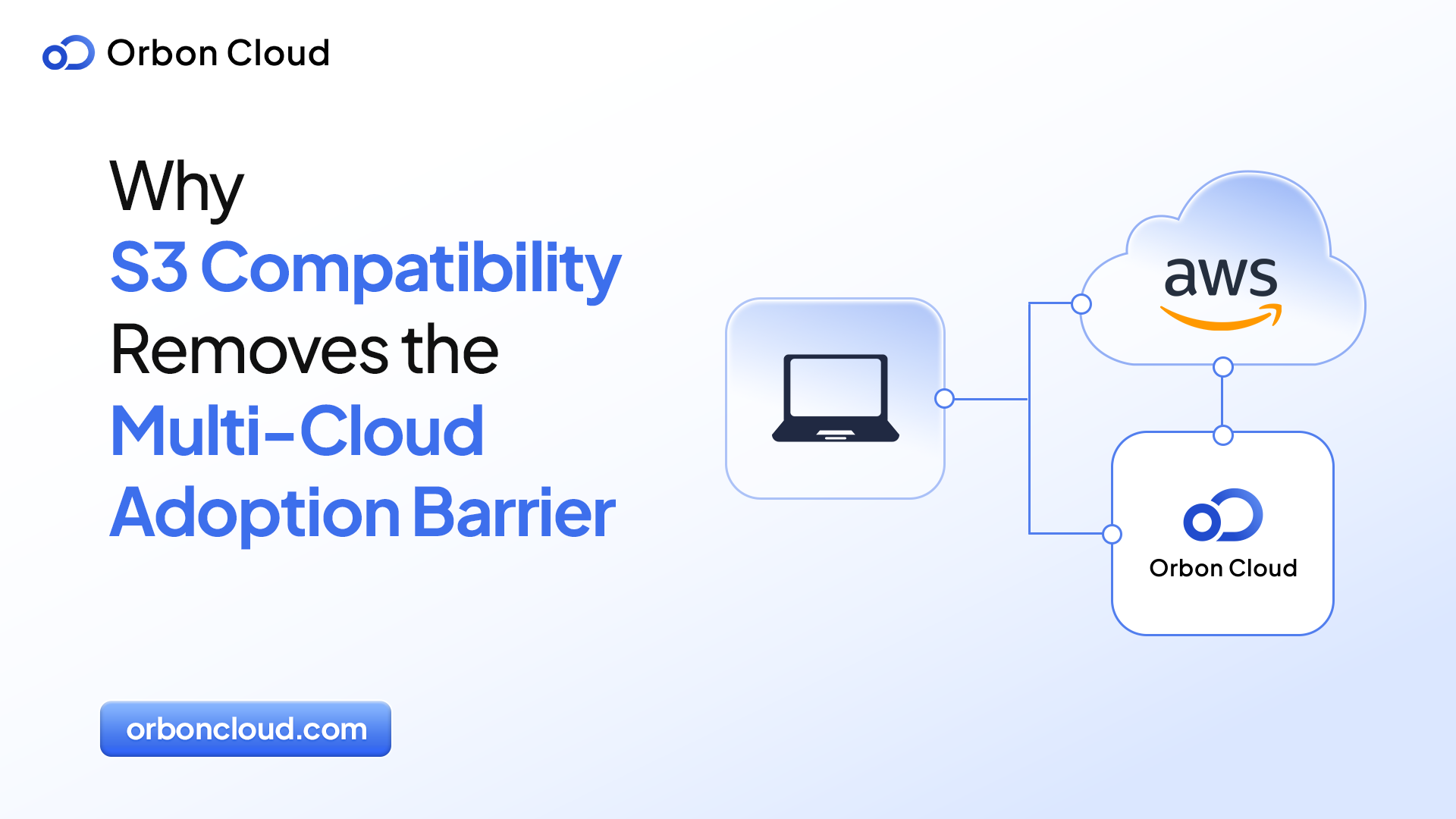
In Cloud, we often talk about "standards" as if they are static rules etched in stone. In reality, a standard is more like a language. It “sticks” not because a committee decided it was the best, but because enough people started speaking it, so much that it becomes culture. In the world of (cloud) data storage, that language is the Amazon Simple Storage Service (S3).
And just like languages evolve to become the root for other languages in an interconnected system of vocabularies, for the modern developer/engineer, Amazon S3 is no longer just a product offered by a single cloud provider. It has evolved into the "Universal Plug" of the Cloud storage space. It is the de facto interface for how we move, store, and retrieve the vast amount of data we store on the cloud. Even with this level of universality, many teams are still skeptical about leveraging this to their advantage.
The secret to breaking those barriers is by focusing on your key business goal. If your goal is to run a profitable business where your cloud operations run as cost-efficiently as possible, then you should be willing to adopt a multi-cloud setup where you can integrate other tools that can help you build a perfect architecture for your business. When you leverage the compatibility of your Amazon S3 architecture, it stops being a "new platform" and starts being an upgrade. It allows you to seamlessly integrate, instead of ripping and replacing everything. Let’s see how and why this new system has become the best way to stay ahead in today’s Cloud landscape.
To understand why compatibility matters, we have to look at where we started. Before 2006, storage was a fragmented mess of local protocols. We used systems like NFS (Network File System) or SMB (Server Message Block), which were designed for computers sitting in the same office, connected by a physical cable. They were never meant for the chaos of the Wide Area Network. They struggled with high latency, dropped connections, and the sheer scale of the web.
When Amazon S3 was launched on Pi Day in 2006, it changed the fundamental "language" of storage. Instead of a complex tree of directories and folders, it introduced a flat architecture of "Buckets" and "Keys." It utilized the same basic HTTP concepts that the web was already built on (GET, PUT, and DELETE).
This simplicity was its greatest strength. S3 was the first "Internet-Native" storage language. It didn't care if your data was ten miles away or ten thousand. It didn't care if you were storing a 1KB text or a 5TB video. Because it spoke the language of the web, every programming language and every server on earth could suddenly ‘speak’ to it. Today, it is the bedrock of the cloud, managing hundreds of trillions of objects and serving as the primary integration point for everything from AI training sets to global content delivery networks.
But why did this Amazon S3 stick while others faded? It’s because S3 honors the mental model of a developer. By treating data as "objects" rather than "files," it removed the administrative overhead of managing hardware. You don't have to worry about disk sectors or partition sizes; you just ask the interface for your object by its name, and the interface delivers it.
Furthermore, S3 introduced a standardized way to handle metadata. In the old world, a file was just a name and a size. In the S3 world, you can "tag" an object with information about its owner, its expiration date, or its security level. This rich metadata layer is what allowed Big Data and Machine Learning to explode. It turned storage from a "dumb bucket" into a searchable, intelligent library.
But it isn’t all rosy as it seems. There are still some caveats to the Amazon S3, especially if you are using it as your sole storage solution as an SME, which is why we recommend that you instead leverage the compatibility of your S3 to adopt a multi-cloud setup.
In practice, 'S3 compatibility' varies significantly across the industry. While many solutions support core functions, they may only cover 70% to 90% of the full API. Relying on an incomplete standard is risky because it introduces inconsistencies that often seem manageable until a specific, advanced feature is required in production.
After all, most people only use the basic GET and PUT commands, right?
In an engineering context, "mostly compatible" is often worse than not compatible at all. It is a hidden bug waiting to happen. Imagine an architect who builds a house using a "mostly standard" electrical socket. Everything works fine for the lamps and the toaster, but the moment the owner plugs in a high-powered appliance, the system fails because a specific grounding pin is missing.
This is the "90% Trap." Many providers skip the "long tail" of S3 features, such as Multipart Uploads, Object Tagging, or complex Bucket Policies. When a developer builds an application, they rely on the standard to behave predictably. If the storage layer fails to handle a specific error code or a signature version correctly, the entire application can crash.
At Orbon Cloud, we believe in Wire-Compatibility. This means we don't just mimic the big features; we match the headers, the signatures, and the error responses exactly. If your code expects a specific response when a file is missing, it gets that exact response. This level of precision is what makes the adoption barrier disappear.
If an adoption requires a total migration, it has already failed the zero-friction test; the best type of upgrades are usually ‘plug-and-use’ extensions. Because Orbon Cloud is that way, i.e., 100% S3 compatible, we enable what we call the "Three-Field Swap."
Think about your current tech stack. Somewhere in your code or your environment variables, you have a configuration file that tells your app where to find its data. To move to Orbon Storage, you don't rewrite your logic. You don't retrain your staff on how to learn to use a new solution for your problems. You simply update three fields:
This is the "Zero-Friction Pivot" in action; it only takes about 60 seconds. This simplicity removes the "Learning Curve" barrier. Your team stays productive because they are using a tool that already plugs into your architecture, whether AWS CLI, Terraform, Boto3, or Snowflake, just with a faster, more efficient engine underneath.
Perhaps the greatest barrier to adopting new infrastructure is the fear of commitment. We are aware you’d probably want to know for certain that this solution is for you before proceeding. Because no matter what promises we make, a responsible engineer would want to test the integrity of the tool before choosing to use it on a daily basis, we understand that.
That is why our solution starts with a fee-free, risk-free, commitment-free proof-of-concept trial, to enable you to test the solution first before proceeding. Here, you can implement a "Shadow Mode" or a "Parallel Test”, where you can point a duplicate stream of your data to Orbon Cloud at no cost, while keeping your primary cloud running exactly as it is.
Now, you can run side-by-side benchmarks, monitor performance, verify the data integrity, and most importantly, check if we live up to our promise of slashing your cloud costs by up to 60%. We are confident that even with this temporary setup, you can watch your egress fees drop to zero in real time, before even adopting our solution long-term. And to sweeten the deal, you don’t have to ‘set it’ yourself; we provide special whiteglove services for integrating our solution. This "Zero-Risk" trial gives you the perfect launchpad to true data sovereignty for your business.
Ready to take that step? Get started with Orbon Storage today.


Join the Alpha Program to stay connected to our innovation. Be first to experience our launch and unlock exclusive member rewards.
Use the links below to see each provider’s latest pricing.





