YAML (Yet Another Markup Language) has been at the centre of modern DevOps. It powers Kubernetes deployments, CI/CD pipelines, and large parts of Infrastructure as Code (Iac). It made storage environments reproducible and gave engineers a uniform language to describe systems.
But unfortunately, as production environments scaled, the role of YAML changed. What started as a simple way to define infrastructure has become a daily operational burden on engineers. It has affected productivity and increased cognitive load on engineers. Maintenance now quietly takes over the time that should be spent building.
This shift matters. Not because YAML is bad, but because the way it is used today has created a hidden tax on engineering teams’ time.
In this article, we’ll look at how YAML-driven Infrastructure as Code (IaC) impacts productivity and cloud costs, and how Orbon Storage reduces the dependency on deep YAML configurations by creating an autonomic storage layer that helps teams spend less time managing configuration.
YAML looks simple. That’s its biggest strength and also its biggest weakness.
While a small YAML file is easy to read, a large one, however, isn’t. A typical production setup could include hundreds of YAML files spread across services, environments, and pipelines; Kubernetes manifests alone can stretch into thousands of lines. Each file carries assumptions, dependencies, and side effects that aren’t visible at first glance.
Engineers don’t just read YAML; they have to interpret it. They try to picture and understand how separate files interact. They trace how a change in one section might affect something deployed weeks earlier.
That mental overhead adds up for engineers, and the time spent understanding configuration starts to rival the time spent building actual features.
This is where YAML stops being a tool and starts becoming a full-time maintenance job.
YAML also lacks basic programming constructs like variables, functions, and reuse. As a result, engineers fall back on copy and paste.
If ten services need similar settings, those settings are copied ten times.
This leads to configuration drift, which occurs when the actual, running state of the infrastructure deviates from the intended state defined in configuration files like the Kubernetes manifests. When something needs to change, such as a security limit or resource policy, teams must manually update dozens or hundreds of files. The process is slow, error-prone, and hard to verify.
Anyone who’s worked with YAML-heavy IaC has seen commit messages like:
It’s frustrating, but more importantly, it’s expensive. Every hour spent reconfiguring is an hour not spent shipping features or improving reliability.
The greater the reliance on YAML, the more time teams spend managing infrastructure definitions rather than systems.
New engineers need time to understand existing configurations. Senior engineers become the only people confident enough to make changes if needed. This causes knowledge to concentrate on a selected few.
When something breaks, the issue often sits in the configuration layer. They often present as a small misalignment between services, a missing parameter or a mismatch between environments.
These problems aren’t dramatic, but they are constant, and constant friction is what slows teams over time. This creates a productivity ceiling. Growth adds more services, more configs, and more dependencies.
The complexity we see today is because current systems only understand instructions and not intent. However, the industry is starting to move in a different direction. The focus is shifting from wiring every detail manually to building systems that ‘self-manage’ with the engineer's intent in mind. Instead of defining how every component should behave, teams describe what they need. The system handles the rest.
This reduces the margin for errors. It also lowers the workload on engineers as they don’t need to track thousands of lines of configuration to understand what the system is trying to achieve.
This is where newer infrastructure models are gaining attention. They don’t remove YAML completely. But they reduce the depth of dependency on it.
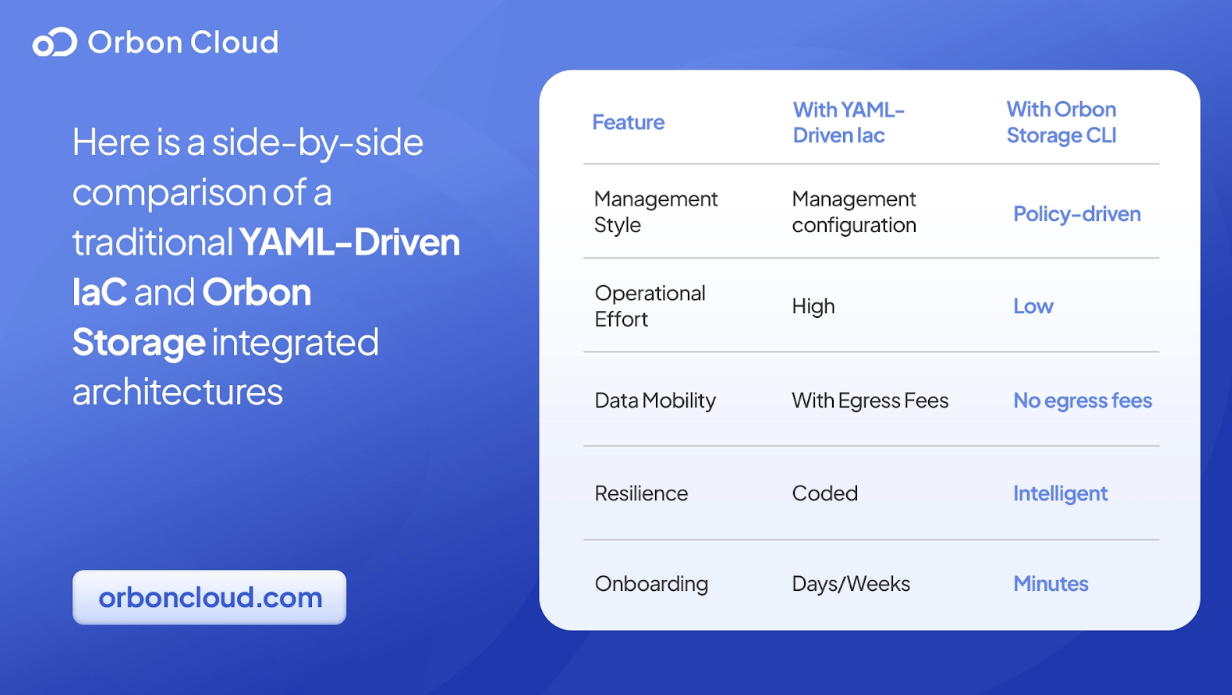
Orbon Cloud is built around reducing manual configuration overhead. The goal isn’t to replace existing tooling or workflows but to add a layer of autonomic utility that makes the storage system self-managing.
What does being Autonomic mean in this context? Well, it means storage, replication, and resilience are handled at the platform level. Teams don’t need to define every policy manually. The system enforces reliability by default, which reduces the number of configuration decisions engineers must make. And because the solution is also S3 compatible, existing setups continue to work, as integrating the Orbon Storage utility is as simple as pointing to a new endpoint..
This changes the day-to-day experience of engineering teams as less time is spent managing infrastructure definitions and more time is spent building and improving products. It’s a practical step away from heavy configuration dependency without forcing a complete shift in architecture.
YAML isn’t going away. It played a major role in shaping modern DevOps and helped standardise how infrastructure is defined and deployed. But the scale of today’s systems has exposed its limits. Now systems need to be a bit smarter.
The problem isn’t the format itself. It’s how much responsibility has been pushed into static configuration. The more teams rely on it to control behaviour, the harder systems become to understand and maintain.
This is where productivity starts to slip. Not because teams lack skill but because the tools demand constant attention. Reducing that burden doesn’t mean reducing reliance on Infrastructure as Code. It means moving toward platforms that absorb complexity instead of exposing it.
This means less time debugging indentation, tracing dependencies, maintaining config sprawl and more time building. It’s time to stop managing files and start managing outcomes.
If you’re ready to explore what the future of cloud architecture looks like without YAML IaC, explore Orbon Storage to learn more.


Join the Alpha Program to stay connected to our innovation. Be first to experience our launch and unlock exclusive member rewards.
Use the links below to see each provider’s latest pricing.





