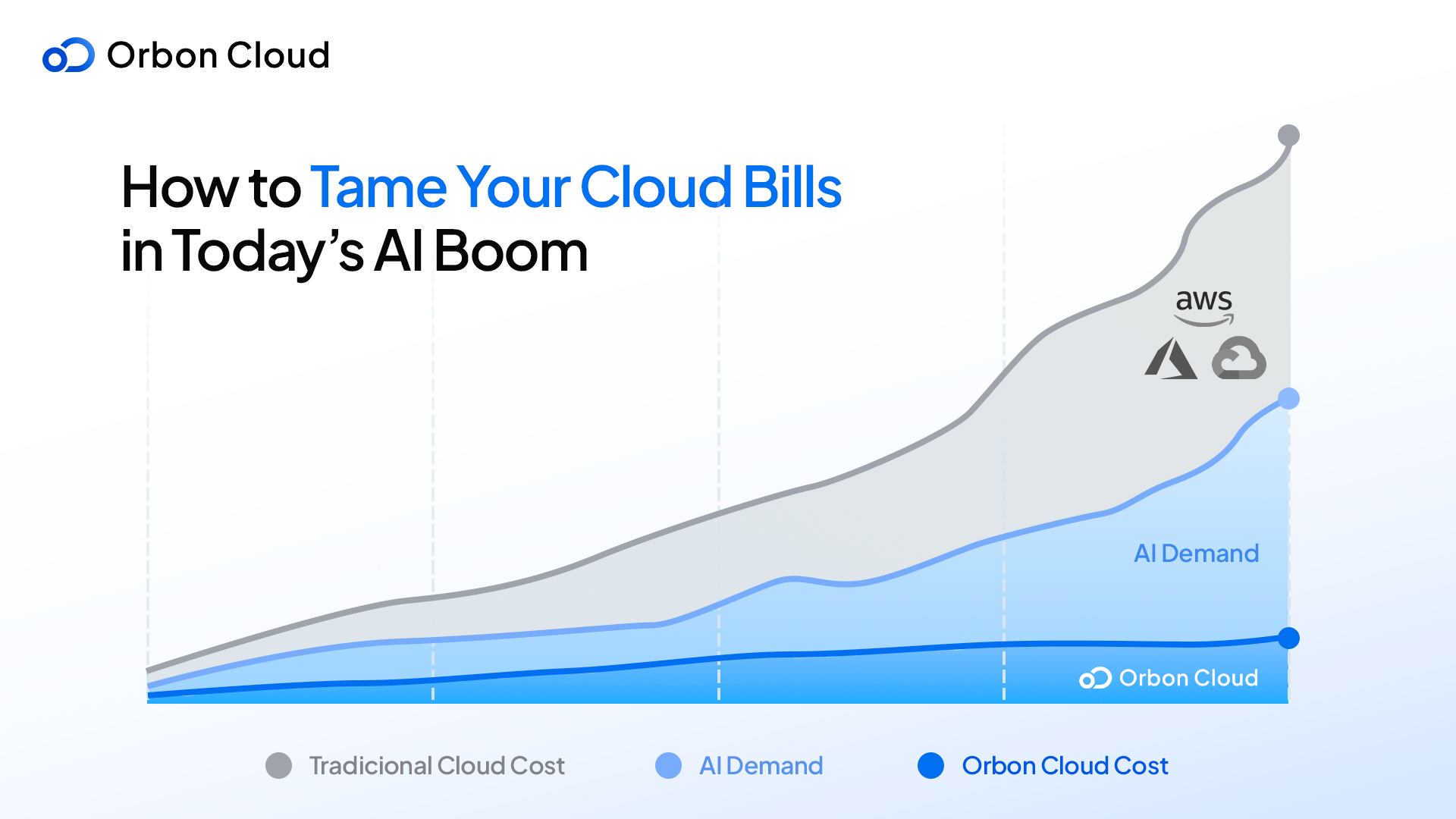
In late 2025, Microsoft imposed a mandatory price increase of 6–12% on every Azure Enterprise Agreement customer. For many businesses, this will land like a punch. The cloud game has basically turned into a punch-dodging contest for the users, and the biggest punch is basically the problem of cost. In this article, we will be delving into this problem and telling you yet again how to dodge this ‘incoming punch’.
Cloud bills have always taken a significant share of most IT budgets. Now, as enterprises reassess their cloud footprint, the cost of staying in Azure is rising again, with an exponential increase in demand for a complementary solution, especially as Generative AI is accelerating cloud usage at a historic rate.
According to a recent TD Cowen survey, organizations expect public cloud spend to quadruple over the next three years, with 42% anticipating that over a third of their cloud budgets will be devoted to AI workloads, including compute and storage.
Make no mistake about it, this isn’t the type of news or trend that gets swept under the rug. This is the kind of shift that rewrites budgets, restructures priorities, and forces finance and engineering leaders to rethink their cloud strategy from the ground up. This directly impacts how much deeper cloud bills are going to dig into your company’s budget for next year and beyond.
Using Azure’s latest price increase as an example, it might look like a small increment on paper, but these increments compound over time, and the ripple effects of the increasing costs will be felt everywhere in the industry.
Microsoft’s adjustment isn’t being framed as a disruption. It’s being positioned as a standard alignment, a reasonable adjustment to match “market conditions”. The reality, however, is far more substantial. For years, through Azure Enterprise Agreement, customers relied on tiered volume discounts to keep their bills predictable; notice how we highlight “predictable” here, not even the increasing prices yet. The model rewards growing your usage, and, in return, you receive better pricing. It was one of the few remaining cost levers enterprises could count on.
But unfortunately, that lever is gone.
The removal of tiered volume discounts rewires the basic economics of Azure consumption. Even if an organization keeps its usage perfectly flat, the cost will still rise. Even if workloads are optimized and commitments planned carefully, the bill will still trend upward. And even if engineering teams do everything “right,” they can’t avoid the baseline increase because the discount structure they depended on no longer exists.
What makes this particularly impactful is that Microsoft isn’t just raising the price of fringe services or luxury features. The 6–12% increase applies to fundamental building blocks: virtual machines, Azure Kubernetes Service, SQL databases, storage tiers, and networking. These are the services every enterprise touches (directly or indirectly), whether they’re running customer-facing applications, analytics pipelines, or internal systems tied to platforms like OneDrive for Business, integrated cloud apps, or modern data hosting services.
This change doesn’t target specific industries, workloads, or usage patterns. It raises the floor for everyone. And given that this is a legacy cloud provider, we expect other providers in the industry to follow suit.
The challenge with cloud pricing, or any change in the cloud industry in general, is that nothing exists in isolation. Everything affects everything else. When one service becomes more expensive, it shifts the cost profile of every application built on it and every company following that strategy. That’s what makes Azure’s 6–12% increase so consequential. It doesn’t just raise the cost of compute or storage for their users; it amplifies the cost of everything that touches those layers.
However, we think there could be something huge prompting Microsoft to make this significant change. Not like we are advocating for them at all, but we believe that the demand from AI could be the ‘body’ pushing the cost, which is subsequently going to push a lot of clients in the industry.
AI workloads are uniquely hungry. They generate terabytes of logs, models, embeddings, vector indexes, rendering, temporary data shards, and training artifacts. They force organizations to store more, move more, replicate more, and retain more data over longer periods of time. Even enterprises that believe they’ve architected efficiently are discovering that each AI feature they deploy multiplies their data footprint.
Because of this, Azure’s price increase relates to the AI growth in a way that magnifies both. The organization that expects a modest 15% rise in data storage needs may see a 30% increase. The company that expands inference capacity by 20% might pay 40% more than projected. And the team that believed their cloud plans were stable will find that even stable usage costs significantly more.
This ripple extends across multi-cloud environments as well. Teams that use Google Cloud Platform services, Google Cloud Storage buckets, or other cloud suites like AWS for specific workflows still move enormous volumes of data in and out of Azure. Every time an analytics job reads from Azure and writes to another cloud, the meter spins faster. Every time a cross-region replication event fires, the new cost takes effect. Even organizations with hybrid or private cloud strategies might feel it. However, would they really feel it, especially the ones stacking special cost-managing utilities to their architecture?
It’s tempting to think there’s no real alternative, that cloud is inherently expensive now, and the only option is to absorb whatever the hyperscalers decide. But the truth is far more optimistic. Many of the most painful cloud cost increases are tied to where organizations store data and how predictable, or unpredictable, their providers’ pricing is.
Data is the reason that makes cloud costs increase. But it's also the easiest lever to control!
What if you knew about a solution that stacks on your current architecture with the specific mission to drive your costs down by eliminating certain operational oversights that inflate your cloud bills? And yes, without you leaving or changing your cloud environment.
There’s a new era of the Cloud, “Cloud 2.0” as we call it, where teams that have successfully contained cloud bills in these recent years didn’t necessarily do it by rewriting their entire architecture. They didn’t rip out their AI pipelines or migrate workloads off their existing cloud environments entirely. Instead, they efficiently managed their cloud operations to minimize their exposure and vulnerabilities to price shocks, mostly with special utility services designed for this exact mission.
Once the data layer becomes portable and predictable, everything else, from compute negotiation to cloud plans to multi-cloud strategies, becomes manageable. The biggest problem isn’t that compute is expensive, or that generative AI consumes resources, it is that storing, moving, and accessing data inside hyperscaler ecosystems carries unpredictable costs.
Egress fees, replication fees, API calls tied to storage operations, cross-region transfers, and slow-moving compliance backups; they all add up.
So in times like this, when there is a price surge to a service that’s unpredictably expensive, the organizations that haven’t already rethought their cloud storage strategy will feel the pressure most. But enough of talking about the problem, here’s a solution we are building for this.
There is a straightforward path forward: move file sharing, backups, and operational data storage to a platform that doesn’t punish you for using your own data.
This is where Orbon Cloud delivers a genuine advantage for you.
Being a utility that latches onto your existing stack, our Autonomic solution helps you efficiently manage your data recovery in order to end up with transparent, predictable pricing, with zero punitive fees. Orbon Cloud gives enterprises a way to stabilize their cloud spend even as legacy clouds’ pricing becomes more volatile. Workloads can remain in Azure. AI pipelines can continue running. Cloud apps and services can stay where they are. While our utility works on your data layer, which is the most expensive component that inflates your bill every time an AI model needs to read a file or an engineering team triggers a backup recovery.
This is how the smarter organizations that will survive these times can absorb the industry’s cost surge without sacrificing innovation or scaling back their initiatives and existing workflows. Cost reduction doesn’t require entirely abandoning what you already have. It simply requires rethinking and restructuring where your data lives and how much you’re willing to pay for it.
When the world’s largest cloud providers make structural changes that raise prices for everyone, controlling your own cloud economics becomes a strategic advantage, not just an operational one.
Orbon Cloud gives you that control.
Now, depending on when you are reading this article, we will soon be launching an Alpha program where we will be proving this concept and how our solution can help you save at least 60% of whatever you are paying as cloud costs now, in a risk-free, fee-free, and commitment-free trial.
We don’t just want you to take our word for it. Let’s show you what our monster can do for your existing storage architecture, without you lifting a finger, and then you can decide from there. The spot is only available to 100 partners. Join now below to stand a chance to be among!


Join the Alpha Program to stay connected to our innovation. Be first to experience our launch and unlock exclusive member rewards.
Use the links below to see each provider’s latest pricing.





