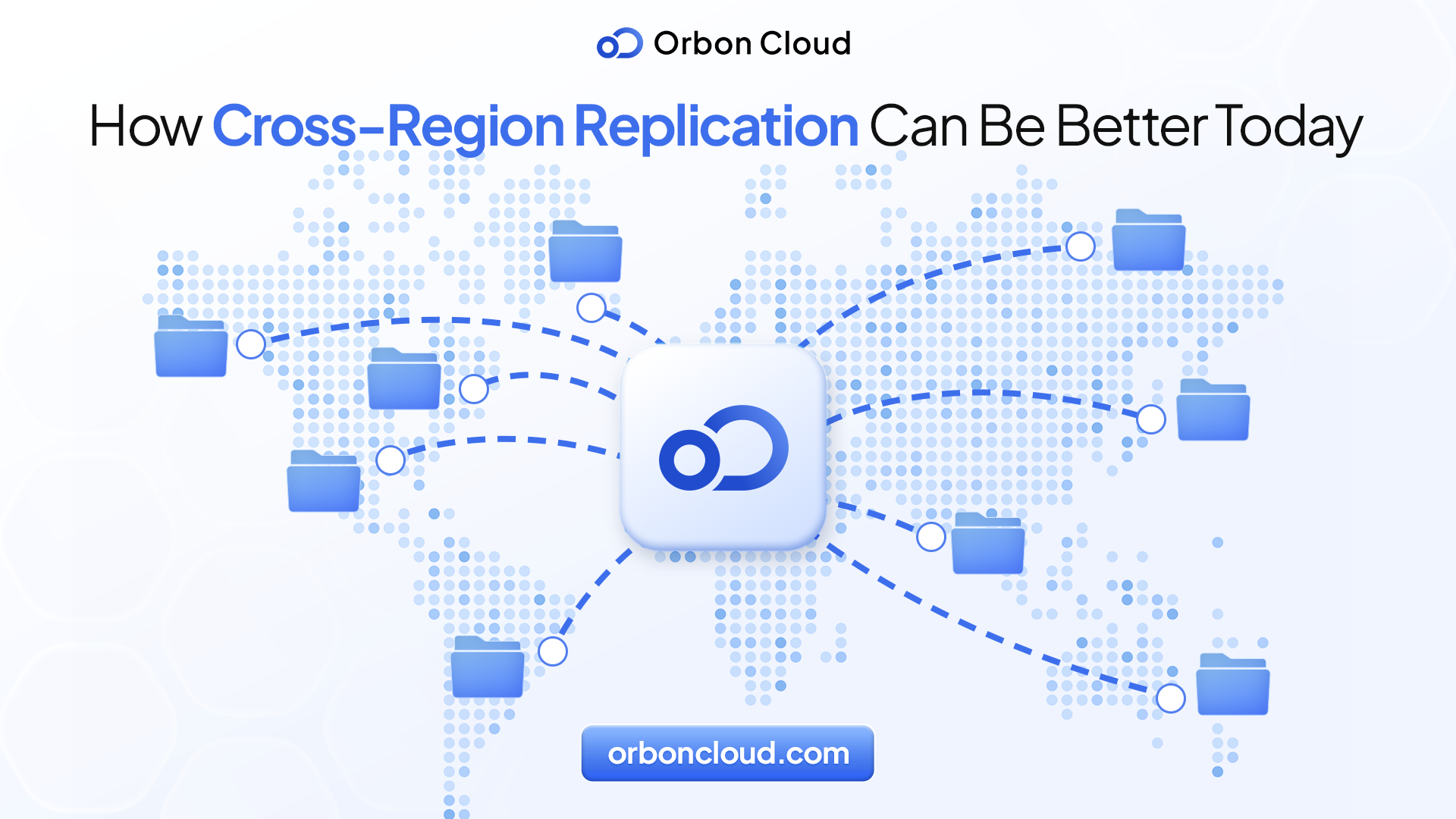
Cross-region replication is often related to a couple of things: resilience, availability, and disaster recovery. For many teams, it is a default box to tick once data starts to matter. But what rarely gets the same attention is cost, not headline pricing, but the slow, compounding spend that builds month after month in the background.
For startups and scale-ups, cross-region replication cost often becomes one of those expenses that looks reasonable in isolation and painful in aggregate. By the time it’s noticed, it’s already baked into architecture, compliance assumptions, and customer SLAs.
Legacy Cloud providers pushed multi-region architectures early, and for good reason. But when centralised infrastructure fails and regions go down, regulators ask hard questions about data durability and availability. Replicating data across regions reduced recovery time objectives and gave teams peace of mind.
The problem is that most teams adopted cross-region replication without a clear cost model. They understood storage pricing. They rarely modelled data movement.
In most public clouds, moving data across regions triggers egress charges. These charges apply even when the data never leaves the provider’s network. Replication traffic is billed as outbound data transfer from the source region, and the cost scales directly with data volume and change frequency.
Replication is not a one-time event; every write matters.
Object storage replication mirrors new objects, updates, deletes, and metadata changes. Databases replicate logs, snapshots, or streams. Event platforms replicate continuously. The cost curve is linear with activity, not just size.
As products mature, data churn increases, logs get richer, backup retrieval becomes more frequent, and analytics pipelines expand. What started as a modest replication setup becomes a permanent tax on growth. This is why cross-region replication cost tends to “appear” later. Early-stage workloads are quiet, and growth workloads are noisy.
Replication itself isn’t the problem. Blind replication is.
Many teams replicate everything, everywhere, all the time. Hot data, cold data, backups, logs, and artifacts are treated the same. This is rarely necessary as selective replication, topic filtering, and replication lag tolerance can change cost profiles.
Storage teams often lag behind this thinking. Object storage replication is usually configured at the bucket level, not the data lifecycle level. That design choice alone can double or triple monthly spend without delivering proportional value.
The problem of compliance is also one to consider. Regulation makes this worse, not better.
When teams operate in Europe, replication often crosses legal boundaries. Data residency requirements force specific regional pairings, sometimes across long distances. Longer paths mean higher costs and higher latency.
At the same time, teams replicate more aggressively “just in case” auditors ask. Replication becomes a compliance blanket rather than a risk-based control.
This is where cost stops being a technical issue and becomes a governance issue. Few finance teams understand why storage costs rise when “nothing changed”, and few engineers are incentivised to explain it.
Hyperscalers price storage cheaply and data movement expensively. This creates a structural incentive to centralise data and minimise movement, which is the opposite of what resilience demands.
Once replication is active, teams are locked into a pattern where safety and spend scale together. There’s no graceful way to separate durability from transfer billing. The replication mechanism works as designed, but the billing model assumes teams accept the ongoing transfer cost as unavoidable. This is not a bug. It’s a business model.
A different way to think about replication is that the next phase of cloud architecture isn’t about removing replication but about rethinking where replication happens and how it’s priced.
Systems that treat replication as a storage-level feature, rather than a network event, change the narrative. When replication traffic is internalised, metered differently, or eliminated through smarter data placement, the cost curve flattens. This is where newer storage platforms, often utilities, quietly diverge from hyperscaler assumptions.
Orbon Cloud, for example, approaches replication from a storage-native perspective. Data is synchronised across locations without traditional egress billing, because replication is not treated as outbound traffic in the first place. The architecture assumes data mobility as a default condition, not an exception to be penalised.
That distinction matters. It means resilience does not automatically imply rising transfer bills; it means teams can design for durability without budgeting for invisible growth taxes.
The financial drain of cross-region replication is not dramatic. It doesn’t trigger alerts and doesn’t break systems. That’s why it survives so long.
Teams that get ahead of it ask different questions. Which data actually needs to be replicated and where? How often? At what latency? Under what failure model? And under which cloud service model?
Replication should be a resilience tool, not a revenue lever for infrastructure providers.
As cloud spending comes under tighter scrutiny, especially for startups operating on thin margins, cross-region replication cost will stop being a niche concern but will become a board-level conversation. So it’s better to start exploring smarter routes now.
The teams that win won’t be the ones that replicate the most. They’ll be the ones that replicate deliberately and choose platforms that don’t punish them for doing the right thing, but help them achieve their goal.
Explore Orbon Storage today to learn how our S3-compatible Hot Replica storage solution can help you reduce data backup and recovery costs with zero-egress-fees!


Join the Alpha Program to stay connected to our innovation. Be first to experience our launch and unlock exclusive member rewards.
Use the links below to see each provider’s latest pricing.





