
The best cloud storage providers with transparent pricing in 2026 are those that offer simple, predictable cost models with zero egress fees. While hyperscalers like AWS, Azure, and GCP provide extensive service ecosystems, their layered billing and data transfer fees create cost uncertainty. Alternatives built on flat-rate, all-inclusive pricing structures provide the clarity needed for accurate budget forecasting.
Choosing a cloud storage provider in 2026 feels like a trap. You compare per-gigabyte prices, only to find your final bill is 50% higher due to fees you never saw coming. This guide cuts through the marketing to give you a framework for identifying true pricing transparency.
Pricing transparency directly impacts your organization's financial planning accuracy and operational stability. According to the Flexera 2025 State of the Cloud Report, many organizations find their cloud spend is over budget by 15-20% due to unforeseen costs.
Budget forecasting accuracy becomes critical for FinOps teams managing annual cloud expenditures. Transparent pricing models enable predictable monthly and quarterly budgets by eliminating variable cost components like egress fees and API charges. This predictability allows finance teams to allocate resources confidently without maintaining large contingency reserves.
Risk management extends beyond cost control to operational planning. Complex pricing structures introduce business risk through unexpected budget overruns that can delay projects or force architectural compromises. Simple, transparent models reduce this operational overhead by eliminating the need for continuous bill auditing and cost optimization analysis.
Growth enablement represents the strategic advantage of transparent pricing. Organizations can scale data usage and access patterns without fear of cost spikes. CIO Dive's analysis of FinOps Foundation data shows that egress fees can account for a significant portion of a total cloud bill, sometimes exceeding the cost of storage itself for data-intensive applications.
But how do you measure transparency? It's more than just a marketing slogan. It requires a clear set of evaluation criteria.
Effective evaluation requires a structured framework for comparing provider pricing models across five critical dimensions.
Criterion 1: Pricing Simplicity evaluates whether the model uses a single metric, such as storage capacity or dozens of metered variables. Simple models typically charge based on storage volume with minimal additional fees, while complex models meter storage classes, API calls, data transfer, and operational activities separately.
Criterion 2: Egress Fee Policy represents the most critical evaluation point. Providers either offer truly free egress, implement caps or discounts, or use fully metered data transfer charges. This criterion directly impacts the total cost of ownership for data-heavy applications and multi-cloud architectures.
Criterion 3: Hidden Fee Disclosure examines how clearly API call fees, retrieval charges, and replication costs are presented. Transparent providers display all potential charges prominently, while others bury fee structures in technical documentation or require sales consultations for complete pricing information.
Criterion 4: Contract Terms and Lock-In analyzes minimum spend commitments, early termination penalties, and data portability restrictions. Transparent providers typically offer flexible terms without punitive exit clauses, enabling architectural flexibility.
Criterion 5: Self-Service Cost Modeling determines whether providers offer simple calculators for total cost estimation or require sales engagement for pricing clarity. Transparent models enable independent cost analysis using straightforward online tools.
Using this scorecard, let's apply it to the major players in the market to see how they stack up.
The following analysis compares major cloud providers across our transparency criteria, revealing significant structural differences in pricing approaches.

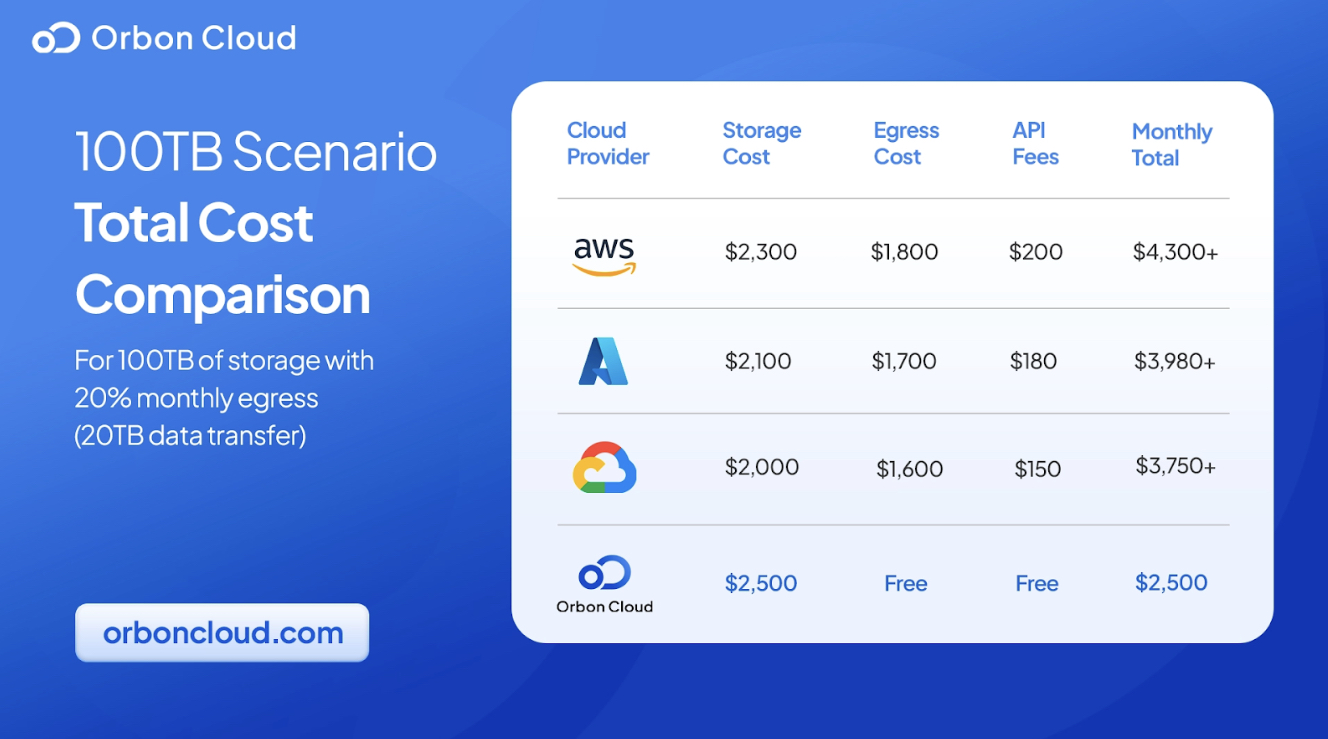
Hyperscalers maintain complex pricing structures across multiple service tiers, storage classes, and geographic regions. AWS S3 pricing includes separate charges for storage, requests, data transfer, and management features. Azure Blob Storage and Google Cloud Storage follow similar multi-variable models with extensive fee schedules.
The numbers show a clear divergence. Let's analyze the fundamental strengths and weaknesses of each approach.
Each pricing model serves different organizational needs and operational requirements, with distinct advantages and limitations.
Strengths include massive service ecosystems with integrated compute, networking, and application services. Global infrastructure provides extensive geographic coverage with sophisticated content delivery networks. These platforms excel for complex, integrated workloads requiring tight service coupling and advanced managed services.
Weaknesses center on pricing complexity and cost unpredictability. Extensive metering creates operational overhead for cost management and budget planning. High egress fees can create vendor lock-in effects, making multi-cloud strategies expensive. Data-intensive applications face significant cost volatility based on access patterns.
Strengths focus on predictable budgeting through zero-egress pricing models that eliminate cost volatility. Simple pricing structures reduce operational overhead for finance and engineering teams. S3-compatible APIs enable seamless migration from hyperscale platforms without application changes. Enterprise-grade compliance through ISO 27001 and SOC 2 Type II certifications supports regulated industry requirements.
Orbon Storage specifically provides autonomic replication and durability management with zero egress fees, creating a predictable total cost of ownership for storage-centric workloads. The architecture eliminates traditional API metering while maintaining enterprise reliability standards.
Weaknesses include smaller service ecosystems compared to hyperscalers. Organizations requiring extensive managed services or specialized regional presence may find limited options outside core storage capabilities.
The best choice depends entirely on your business needs. Here's a simple guide to help you decide.
Strategic provider selection depends on workload characteristics, organizational constraints, and operational priorities.
Best for Enterprise (Deeply Integrated): Hyperscalers may be appropriate if you're already integrated into their ecosystem with extensive use of managed services, serverless functions, and platform-specific tools. Large FinOps teams can manage pricing complexity through dedicated cost optimization processes.
Best for SaaS and Media (High Egress): Transparent alternatives with free egress provide significant cost advantages for applications with heavy data transfer requirements. Content delivery, backup services, and data analytics workloads benefit from predictable pricing without transfer penalties.
Best for Backup and Archive: Hybrid approaches can work effectively, but careful evaluation of retrieval fees from hyperscaler cold storage tiers is essential. Transparent alternatives often provide simpler archive pricing without complex retrieval cost structures.
Best for Startups (Needing Predictability): Transparent models provide the cost certainty needed to manage burn rate effectively. Predictable monthly expenses enable accurate financial planning without surprise cost spikes that can impact runway calculations.
Ultimately, making the right choice comes down to asking the right questions. Here is your final checklist.
Use these questions to evaluate any cloud storage provider's true pricing transparency and total cost implications.
Request actual billing examples that demonstrate how charges appear and accumulate across different usage patterns.
Understand all data transfer charges, including cross-region replication, CDN integration, and API-driven access patterns.
Clarify whether application interactions incur separate charges and how these scale with usage volume.
Evaluate retrieval fees, minimum storage durations, and early deletion penalties for archived data.
Understand disaster recovery and compliance replication costs across geographic regions.
Review minimum retention requirements and associated charges for storage tier changes.
Clarify support pricing models and service level availability without additional fees.
Ensure data portability without prohibitive export charges or technical barriers.
Understand how sudden traffic increases or access pattern changes affect monthly costs.
Request comprehensive cost modeling, including all potential fees and operational charges.
For organizations prioritizing cost predictability and operational simplicity, Orbon Storage offers a transparent alternative with zero egress fees and S3-compatible integration. Ready for a transparent pricing model? See how Orbon Storage compares.


Join the Alpha Program to stay connected to our innovation. Be first to experience our launch and unlock exclusive member rewards.
Use the links below to see each provider’s latest pricing.





